

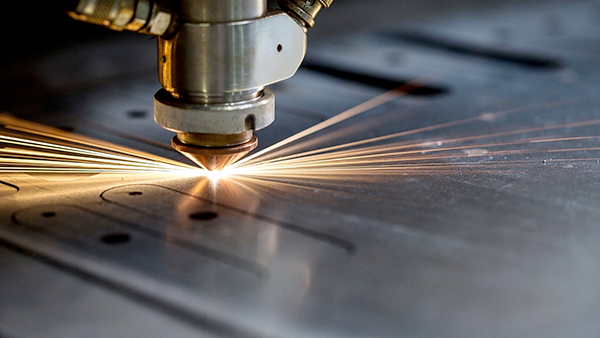
What is a plasma cutting arc? How does it differ from laser cutting? Changzhou Maiqiwei CNC Technology Co., Ltd. will introduce the characteristics of a plasma cutting arc. A plasma cutting machine, also known as a plasma power supply, is a machine that uses plasma cutting technology to process metal materials.Plasma cutting utilizes the heat of a high-temperature plasma arc to partially melt (and evaporate) the metal at the workpiece's cut edge. The momentum of the high-speed plasma then removes the molten metal, forming a cut. Plasma cutting machines, when used with different working gases, can cut various metals that are difficult to cut with oxygen cutting, especially non-ferrous metals (stainless steel, aluminum, copper, titanium, nickel). Its main advantages are high cutting speed, especially when cutting thin sheets of ordinary carbon steel, where the speed can be 5-6 times that of oxygen cutting, resulting in a smooth cut surface, minimal thermal deformation, and almost no heat-affected zone.As plasma cutting machines have evolved, the working gas (which is the conductive medium of the plasma arc, the heat carrier, and also removes molten metal from the cut) has a significant impact on the cutting characteristics, quality, and speed of the plasma arc.
2026-03-12 13:50:01 Detail>>
Currently, it's peak season for CNC cutting machines, and many manufacturers have already prepared their procurement plans before the new year. However, they are unsure which type to choose. Here, we emphasize the advantages of Maiqiwei CNC gantry CNC cutting machines: As a CNC cutting machine manufacturer, we have our own advantages in understanding product performance. Gantry CNC cutting machines offer good stability and produce high-quality cuts on thick steel plates. However, the investment cost is higher. In comparison, portable CNC cutting machines are better for general processing enterprises, offering lower economic burden and greater practicality.The height adjustment system of CNC plasma cutting machines is familiar to most, but many only have a basic understanding and haven't delved deeper into its details. Now, the CNC cutting machine manufacturer will explain the height adjustment system in detail: During the cutting process with a CNC flame cutting machine, to ensure a high-quality cut, the height of the cutting nozzle from the surface of the workpiece must remain basically consistent. This can be quite difficult for manual operation, especially when the surface of the material being cut is not very smooth or the cutting environment is limited, making it even more important to maintain a stable cutting height. To overcome the problem of unstable height control during manual cutting, CNC flame cutting machines have developed a dedicated automatic height adjustment control system. This system automatically maintains the distance between the cutting nozzle and the steel plate at a set height during flame cutting to improve cutting quality.
2026-03-12 13:49:30 Detail>>
While CNC plasma cutting machines were already being used to cut metal materials abroad 40 years ago, my country lagged behind foreign companies by 30 years. However, with reform and opening up and economic development, my country's CNC precision plasma cutting machine technology has matured significantly, and its research and development level has continuously improved. High-tech products are constantly being developed and successfully launched into the market, making domestically produced equipment a strong competitor to imported equipment, especially in the shipbuilding industry.The main types of CNC plasma cutting machines include: conventional plasma arc cutting, dual-gas plasma arc cutting, waterjet plasma arc cutting, long-life oxygen plasma arc cutting, and CNC precision plasma cutting machines.Many shipbuilding companies now aim for precision shipbuilding and construction, thus placing increasingly stringent demands on cutting techniques. The successful development of CNC precision plasma cutting machines has made this goal a reality for the shipbuilding industry.Previously, many industries opted for CNC laser cutting machines for high-precision cutting due to their advantages such as high cutting speed, high precision, good cutting quality, and high work efficiency. However, the development of domestic laser cutting machines lagged behind, leading many companies to choose imported products, which resulted in higher costs and hindered the development of domestic laser cutting machines. Furthermore, CNC laser cutting machines had several drawbacks when cutting medium-thick plates. Solving these problems, while effectively ensuring work efficiency and cutting quality, while reducing production costs, has spurred the development of CNC precision plasma cutting machines.CNC precision plasma cutting machines feature high arc current density and, with the introduction of rotating magnetic field technology, excellent arc stability, resulting in extremely high cutting precision. Precision plasma cutting reduces operating costs while achieving high precision, costing only one-third that of laser cutting. Therefore, it has gained favor in many industries, especially shipbuilding.The development of CNC precision plasma cutting technology not only solves the problems of low work efficiency, low material utilization, and unstable quality in my country's thermal cutting industry but also drives the development of other related fields.
2026-03-12 13:48:56 Detail>>
1. High Digitalization and Automation of Welding and Cutting EquipmentA major highlight of this welding exhibition is the high level of digitalization and automation of welding and cutting equipment. Besides stick arc welding and argon arc welding equipment, most welding and cutting equipment use NC (numerical control) systems and human-machine interfaces. Operators can freely set welding parameters or program welding procedures through the human-machine interface depending on different welding components and store the programs in the NC control system, which can hold hundreds of welding programs, achieving intelligent welding. When paired with robot or mechanical arm systems, full-range automated welding or cutting can be realized. This not only reduces labor intensity and greatly improves efficiency but also ensures stable, reliable, high-quality welds with good repeatability and reproducibility of welding processes and consistency of weld quality.Major manufacturers are sparing no effort to attract visitors' attention. For example, ABB uses two robots to 'work' cooperatively, with each robot arm 'holding' a display screen about the size of a home TV, together forming a complete image. FANUC showcases two robots cooperating to 'weld' the lines on a basketball. As is well known, the basketball surface has many lines, and the pattern of these lines represents the shapes of various complex welds, such as saddle shapes and intersecting lines. Achieving these welds with only one welding robot is difficult, but using two robots in cooperation makes it easy. FANUC has effectively solved these challenges, and from their exhibit, it is evident that they have resolved them quite elegantly.The coordinated movement of robots is a major highlight of this Essen Exhibition. A traditional welding robot equipped with a single rotary table has only 8 degrees of freedom. Although it can weld some complex seams on complex-shaped workpieces, with the development of small-batch and diversified products, one robot with one rotary table is no longer sufficient. Coordinated movement of two robots provides a total of 12 degrees of freedom, greatly increasing flexibility and allowing handling of various complex welds, as shown in Figure 1. If these technologies are applied to welding large structural components in the defense industry, such as vehicle bodies and turrets, they can achieve high-speed welding, reduce manufacturing costs, and significantly shorten production cycles.2. Increased Welding Equipment Power and Equipment MiniaturizationTo meet the production needs for welding some thick components, various high-power welding equipment has emerged, especially high-energy beam welding equipment such as laser and electron beam welding machines. With breakthroughs in key equipment manufacturing technologies, some high-power or ultra-high-power welding equipment has already been produced. Currently, high-power lasers can reach over 10kW and are used for welding combination gears and thick plates. The UK CVE's high-power electron beam welder can reach over 100kW, capable of fully penetrating 380mm thick stainless steel plates in a single pass, and can also be applied to electron beam freeform manufacturing and precision surface forming, providing a broader prospect for the application of high-energy beam processing technologies in manufacturing.
2026-03-12 13:46:53 Detail>>
The products are exported to Jiangsu, Shanghai, Beijing, Hubei, Hunan, Guangzhou and other provinces and cities, and the sales network is all over the place, and the products are well received by users



Contact us

